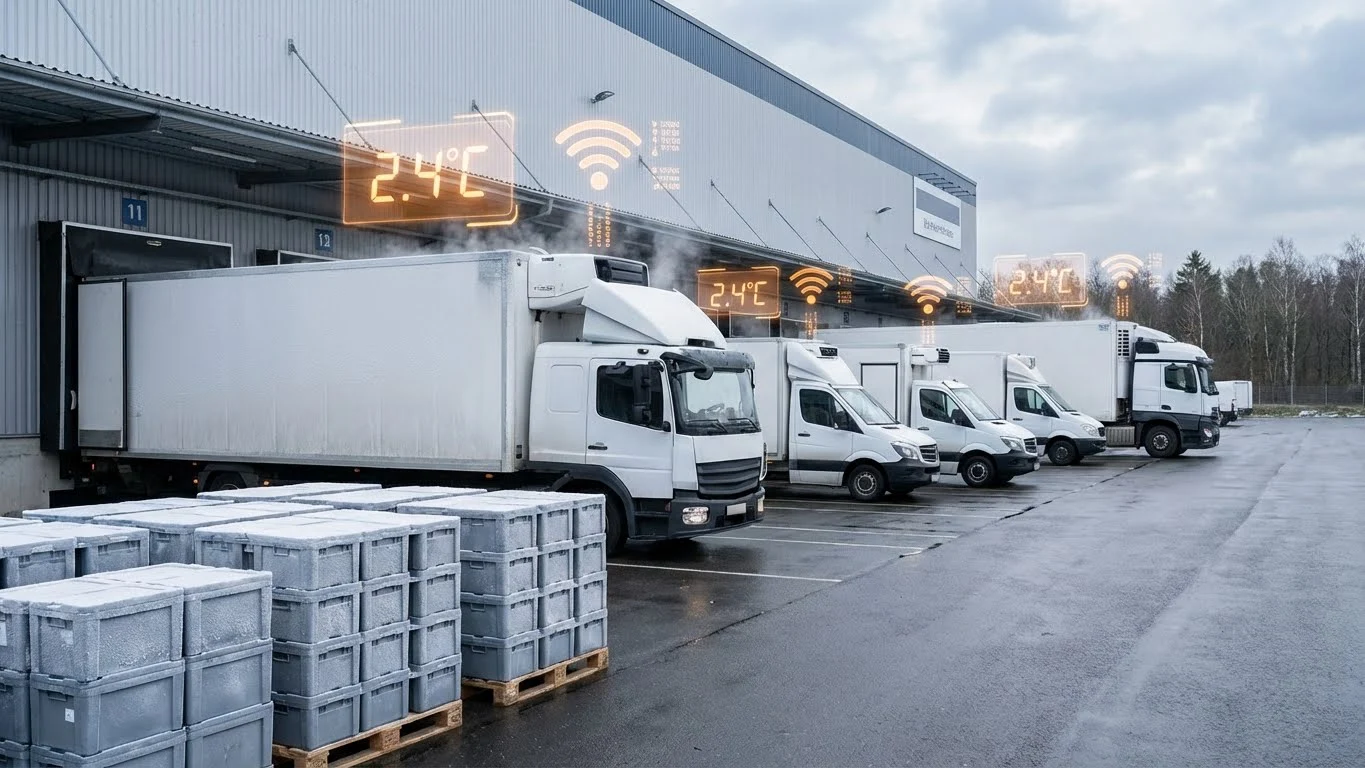
1. Precision at Every Mile: Reefer Unit Monitoring
Traditional temperature checks are very prone to making mistakes due to the nature of the process itself.
On the other hand, reefer unit monitoring provides the continuous capture of temperature and humidity data throughout the journey. The fleet managers and logistics teams are able to monitor each truck in real-time, which guarantees that the cooling systems stay within the limits set beforehand.
As soon as there is a temperature deviation, automated temperature deviation alerts immediately notify operators, allowing for prompt corrective action prior to spoiling.
2. Compliance Beyond Paperwork
Industries dealing with perishable goods or medicines are obliged to comply with very strict worldwide standards, such as those laid down by HACCP and Good Distribution Practice (GDP), among others.
Compliance now extends far beyond paperwork; it requires traceable, validated evidence of consistent temperature control.
The systems of real-time data logging and sensor calibration not only secure food safety compliance but also make digital audit trails the support thus offering transparency to the customers as well as to the regulatory authorities simultaneously.
3. From Reactive to Predictive: The Role of Analytics
Advanced cold chain systems combine thermal mapping and humidity sensors to recognize weak spots before they eventually break down. Logistics managers can analyse historical temperature data, logistics managers can predict recurring deviations or discrepancies caused by bad insulation, slow loading, or defective cooling machinery. This capability of predicting enables moving the maintenance from troubleshooting when the problems occur to controlling the quality control management when it is still possible to prevent spoiled products losses and to enhance consistency of deliveries.
4. Securing Cargo Integrity Through Connectivity
The modern-day refrigerated logistics systems powered by IoT technology have integrated GPS tracking with environmental monitoring, thus providing complete supply chain traceability.
The containers work as a network of interlinked systems that send out live updates on temperature, humidity and movement of the goods inside.
If there is any change in the conditions, the system will automatically inform, and the route analytics will be utilized to ensure that the cargo integrity remains in good condition from the storage place to the shop shelf, no matter the distance or weather conditions.
5. Cold Storage Solutions that Think Ahead
Thermal mapping and humidity sensors are integrated into advanced cold chain systems to find any weak points before they break.
Humidity and temperature sensors provide constant feedback that helps the companies to maintain microclimates suited to each product type, whether dairy, seafood, vaccines, or chemicals.
With energy efficiency being the main concern, the advanced cold storage solutions will be a step towards eco-friendliness while still guaranteeing the desired temperature level.
Energy efficiency being the top priority, the storage plan will be a move toward green practices and at the same time, ensuring the required temperature.
Conclusion: Precision Preserves Profit
In a worldwide market, one error can ruin the whole shipment. Constant temperature tracking is the foundation of reliable cold chain operations.
Real-time temperature monitoring is the backbone of dependable cold chain operations.
Present-day cold chain success is no longer just about controlling the temperature; it is about controlling the process.